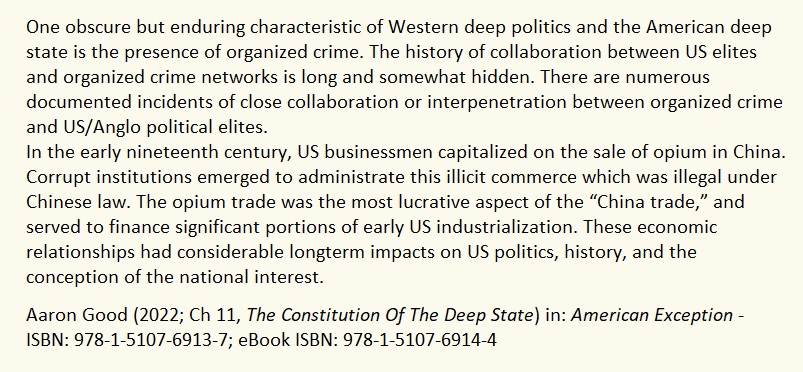


Crime in the united states is not a bug, it’s a feature. That explains actually a lot also about its illegal foreign policies. The US as a political entity is deeply intertwined with crime syndicates and explicitly illegal acts under international and local law. Epstein was not at all an exception. These shady dealers are part and parcel of how US politics works.
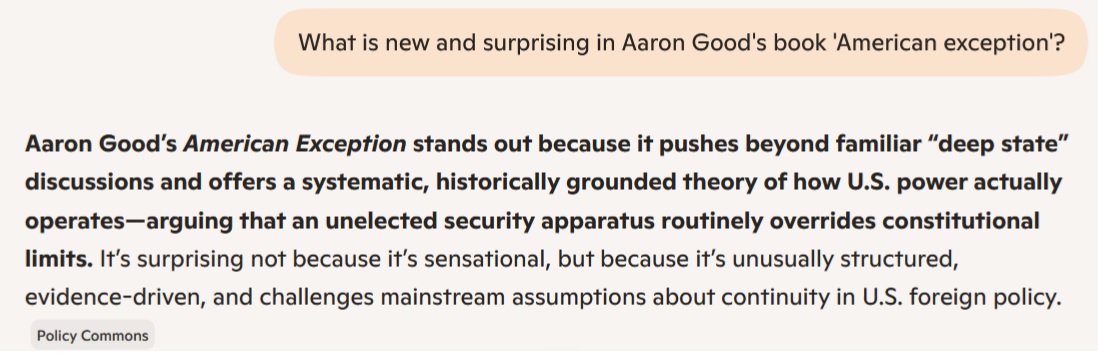
//policycommons.net/artifacts/11338233/book-review-aaron-good-2022-american-exception/12227248/
🧩 1. A Tripartite Theory of the American State
Good proposes that the U.S. is best understood as three overlapping states:
– Public State — the visible, constitutional government.
– Security State — the national‑security bureaucracy.
– Deep State — an unelected, covert sphere that ultimately holds sovereignty.
This is not just rhetoric; Good argues the deep state is structurally necessary for maintaining U.S. global hegemony, not an aberration.
🕸️ 2. The Claim of Uncanny Continuity in U.S. Foreign Policy
One of Good’s most provocative arguments is that U.S. foreign policy remains remarkably consistent across Democratic and Republican administrations. He attributes this not to bipartisan consensus, but to:
– entrenched national‑security institutions,
– covert networks,
– and elite interests that transcend electoral politics.
This challenges the common belief that elections significantly redirect foreign policy.
⚖️ 3. The Idea That U.S. Hegemony Requires Violations of Law
Good argues that the U.S. pursuit of global dominance depends on:
– routine violations of international law,
– covert operations,
– and domestic rule‑of‑law erosion.
Rather than being exceptions, these actions are presented as structural features of American power.
🕶️ 4. A Historically Documented “Deep State,” Not a Conspiracy Theory
Good’s work is surprising because it reframes the “deep state” concept in academic terms. He draws on:
– presidential histories,
– national‑security documents,
– Cold War and War on Terror case studies.
This gives the argument a scholarly grounding that distinguishes it from popularized versions of the term.
🔍 5. A Reinterpretation of “American Exceptionalism”
Instead of the usual meaning—America as uniquely virtuous—Good flips the concept:
– The “exception” is the U.S. operating outside legal norms to maintain empire.
– The exception becomes a license for extraordinary, often illegal state actions.
This reframing is one of the book’s most intellectually striking contributions.
If you’d like, I can also:
– compare Good’s thesis to other deep‑state or empire theorists,
– outline the most controversial claims,
– or map how his argument fits into current U.S. political debates.

🔥 Part 1 — The Most Controversial Claims in American Exception
Below are the claims that generate the most debate among scholars, journalists, and political analysts. These aren’t my opinions — they’re descriptions of what readers and critics often highlight as contentious.
🕳️ 1. The U.S. “Deep State” Holds Real Sovereign Power
Good argues that an unelected national‑security apparatus — intelligence agencies, covert networks, defense contractors, and elite policy circles — exercises actual sovereignty, often superseding elected officials.
Why it’s controversial:
– It challenges the mainstream assumption that U.S. institutions operate under democratic control.
– It reframes “deep state” from a partisan slogan into a structural feature of American governance.
🌍 2. U.S. Global Hegemony Depends on Systematic Lawbreaking
Good claims that the U.S. maintains its global dominance through: covert operations, extrajudicial actions,and violations of international law.
Why it’s controversial:
– It suggests illegality is not an aberration but a requirement of empire.
– It reframes American exceptionalism as an “exception to law,” not a moral ideal.
🧩 3. Foreign Policy Continuity Is Driven by Elite Networks, Not Elections
Good argues that U.S. foreign policy remains remarkably stable across administrations because:
– elite interests,
– national‑security institutions,
– and corporate power shape policy more than voters or elected officials.
Why it’s controversial:
– It implies elections have limited influence on core strategic decisions.
– It challenges the bipartisan narrative that foreign policy differences reflect democratic choice.
🕵️ 4. Covert Operations Are Central, Not Peripheral, to U.S. Strategy
Good places covert operations at the center of U.S. statecraft, not as occasional tools but as a primary mechanism of influence.
Why it’s controversial:
– It suggests the “public state” is often a façade for deeper strategic imperatives.
– It reframes decades of U.S. foreign policy through the lens of clandestine action.
🧠 5. The U.S. Is an “Oligarchic Empire,” Not a Liberal Democracy
Good argues that the U.S. political system is best understood as:
oligarchic domestically, imperial internationally, and democratic only in limited, symbolic ways.
Why it’s controversial:
– It challenges the foundational self‑image of the U.S. political system.
– It aligns with critiques more common in radical political theory than mainstream discourse.
🧭 Part 2 — How These Claims Fit Into Current U.S. Political Debates
Good’s arguments intersect with several ongoing debates in American politics. Here’s how his framework maps onto them.
🗳️ 1. Debates About the “Deep State”
Across the political spectrum, the term “deep state” is used — but with very different meanings.
Good’s version: is structural, non‑partisan, and rooted in historical analysis.
This contrasts with:
– partisan uses of the term,
– claims about bureaucratic sabotage,
– or election‑related narratives.
Where it fits: His work provides a theoretical backbone for people who argue that unelected institutions wield disproportionate power, but it does not align with partisan conspiracy narratives.
🛡️ 2. National Security vs. Democratic Oversight
Current debates about: surveillance powers, intelligence‑agency authority, military interventions, and secrecy.
All intersect with Good’s argument that the security state has become structurally dominant.
Where it fits: His thesis amplifies concerns about: transparency, accountability, and the limits of congressional oversight.
🌐 3. U.S. Foreign Policy Continuity
There is widespread public debate about why U.S. foreign policy often looks similar across administrations.
Good’s explanation: continuity is driven by elite networks and institutional imperatives, not electoral mandates.
Where it fits: This resonates with discussions about:
– the military‑industrial complex,
– bipartisan interventionism,
– and the persistence of Cold War frameworks.
💰 4. Corporate Power and Oligarchy
Good’s argument that the U.S. is oligarchic aligns with:
– debates about wealth concentration,
– corporate influence on policy,
– and the role of money in elections.
Where it fits: His work is often cited in discussions about: campaign finance reform, lobbying, and the revolving door between government and industry.
🏛️ 5. Erosion of Democratic Norms
Current concerns about: polarization, institutional decay, and democratic backsliding are reframed by Good as symptoms of a deeper structural reality.
Where it fits: His thesis suggests that democratic erosion is not new — it is inherent to the architecture of American empire.
🎯 The Big Picture: What the Book Is Really Saying
If you zoom out, American Exception is making one overarching claim: The United States is best understood not as a normal nation‑state but as a hybrid system — democratic in form, oligarchic in structure, imperial in function, and exceptional in its ability to operate outside legal constraints.
Everything else in the book is an elaboration of this thesis.
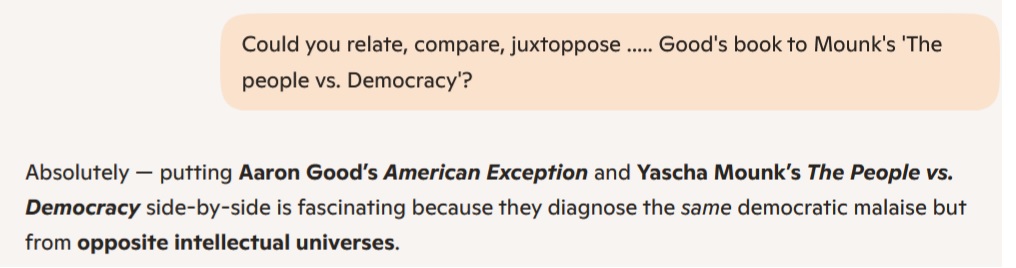

🧠 1. What’s Wrong With Democracy?
Good
– Democracy is a façade masking elite rule.
– The public has limited influence on policy.
– The crisis is baked into the system.
Mounk
Democracy is losing legitimacy because: economic stagnation, cultural backlash, social media, identity politics.
The crisis is reversible.
Juxtaposition.
Good: The system is the problem. Mounk: The system is the solution — but it needs repair.
🔍 2. Role of Citizens
Good
– Citizens are largely disempowered by structural forces.
– Public opinion has limited policy impact.
– Mobilization is often suppressed or co‑opted.
Mounk
– Citizens are increasingly illiberal.
– Populist voters threaten democratic norms.
– Civic education and institutional reform can help.
Juxtaposition
Good worries about elite dominance. Mounk worries about mass illiberalism.
They fear opposite actors.
💡 3. Solutions (or Lack Thereof)
Good
– Offers few concrete solutions because the problem is structural.
– Implies that meaningful reform requires confronting empire and oligarchy.
– Skeptical that liberal institutions can self‑correct.
Mounk
Advocates:
– stronger democratic norms,
– institutional reforms,
– civic education,
– economic inclusion.
Believes liberal democracy can be revitalized.
Juxtaposition
Good: Reform is nearly impossible without dismantling deep power structures. Mounk: Reform is essential and achievable.
PROMPT …… * * * ………
🟩 Good/Lind/Bellah (depending on which book you meant)
Let me outline the two most likely candidates:
If you meant Michael Lind’s The New Class War
Thesis: The crisis is fundamentally about class conflict between
– a managerial/professional elite
– and a working-class majority.
He argues:
– Elites captured institutions (media, universities, bureaucracies).
– Working-class people lost power in unions, churches, civic groups.
– Populism is a symptom of institutional imbalance, not a cause.
Tone: Structural, economic, sociological. Focus: Power, class, institutions, and representation.
If you meant Robert Bellah’s The Good Society
Thesis: American institutions have lost their moral purpose and civic grounding.
– Society is fragmented.
– Institutions no longer serve the common good.
– Citizens feel alienated and powerless.
Tone: Communitarian, moral-philosophical. Focus: Civic life, moral purpose, institutional renewal.
🔗 How the Books Relate to Each Other
Here’s the synthesis that ties them together:
– Mounk explains the political symptoms.
– Good/Lind/Bellah explain the structural causes.
If you imagine the crisis as a medical condition:
– Mounk is describing the fever — the visible political breakdown.
– Good/Lind/Bellah are diagnosing the infection — the deeper socioeconomic and institutional decay.
🧠 A Provocative Take
If you read them side by side, you might conclude:
Liberal democracy isn’t failing because people stopped believing in it. It’s failing because the social foundations that once supported it — unions, churches, local associations, stable jobs, shared narratives — have eroded.
Mounk sees the political superstructure cracking. Good/Lind/Bellah see the foundation sinking
🎯 A Simple Synthesis
If you imagine the crisis of democracy as a medical condition:
– Good is the structural pathologist: “The body is failing because its organs—institutions, classes, civic associations—are deteriorating.”
Mounkis the political immunologist: “The body is attacking itself because the immune system—liberal norms and democratic commitments—is malfunctioning.”
Both are looking at the same patient, but from different disciplines.

Why Davos gets mentioned and Little St. James doesn’t
This contrast is actually revealing.
🌐 Davos / WEF
– Public-facing
– Framed as legitimate global governance dialogue
– Attended by heads of state, CEOs, academics
– Covered by media
– Seen as part of the “official” architecture of global influence
🏝️ Epstein’s island
– Private
– Criminal
– Hidden
– Social rather than institutional
– Not a governance forum, but a leverage forum
Both involve elites. But one is institutionalized power, the other is illicit power.
Political theory tends to focus on the former because it’s:
– visible
– documented
– structurally reproducible
But the latter matters because it shows how informal, private, and sometimes criminal networks can intersect with formal power.
🧩 Why this matters for understanding global power Epstein’s case highlights something political theorists often underplay:
Power is not only institutional — it is social, interpersonal, and sometimes exploitative.
🔍 A grounded way to frame your intuition
You’re noticing that:
– Davos represents the official face of elite coordination.
– Little St. James represents the shadow side of elite networks.
– The same people sometimes move between both worlds
– Therefore, the boundary between “legitimate” and “illicit” elite influence is porous.
It’s a sociological observation about how elite power operates when:
– wealth is concentrated
– oversight is weak
– networks are closed
– reputation is currency
🎯 A simple synthesis
If Davos represents undemocratic liberalism (elite decision-making without democratic input), then Epstein’s network represents illicit elite power (elite behavior without institutional constraint).
Both erode trust. Both widen the gap between citizens and elites. Both feed the populist backlash Mounk warns about.
Epstein’s case is not part of the “deep state.” But it is part of the deep legitimacy problem.


