

🐭 What Burns Is Really Saying in “To a Mouse”
At first glance, it’s a simple scene: a farmer ploughs up a mouse’s nest and apologizes to the terrified creature. But Burns uses that tiny moment to make a much larger, very human point.
🌾 1. Humans and animals share the same vulnerable existence
Burns speaks to the mouse as an equal—almost as a neighbor. He insists that the mouse has every right to live peacefully and that humans, with all their power, often cause needless harm.
😔 2. The mouse lives wisely in the present; humans suffer by looking backward and forward
One of the poem’s most famous lines captures this contrast: The present only toucheth thee
The mouse worries only about now. Humans, Burns says, are burdened by regret and anxiety—our minds constantly pulled between past mistakes and future fears.
📉 3. Even the best plans can collapse
This is where the poem becomes universal. Burns reflects on how fragile life is, how easily our hopes can be overturned by chance. The line everyone knows sums it up: The best laid schemes o’ Mice an’ Men / Gang aft agley, ….
Plans—whether made by a mouse building a winter nest or a human building a life—can go wrong through no fault of our own.
🎯 In short
“To a Mouse” isn’t really about a mouse. It’s about the human condition—our vulnerability, our tendency to overthink, and our shared fate with every living thing. Burns uses the mouse as a mirror, and what he sees reflected is our own anxious, hopeful, fragile selves.
If you want, I can also walk you through the poem stanza by stanza, or compare it to Of Mice and Men, which takes its title directly from Burns’s line.
🐭 1. The man with a tail — cat, mouse, or something in‑between?
Giving a human figure an animal tail is a classic cartoonist’s trick. It blurs categories:
– If he’s a cat: He becomes a natural predator, someone who thinks he has the upper hand over the mouse he’s holding.
– If he’s a mouse: Then the power dynamic collapses. He’s not a predator at all — just a larger, more pompous version of the small creature he’s trying to dominate.
– If he’s neither: The tail becomes a symbol of regression — a reminder that beneath suits, flags, and political posturing, humans are still animals driven by instinct, fear, and territorial behavior.
The ambiguity is the point. A tail can be a badge of power or a mark of foolishness.
🐁 2. The mouse — small, vulnerable, but symbolically potent
In cartoons, mice often stand for: the underestimated, the nimble, the survivor, the one who slips through the cracks of big systems.
A mouse is never just a mouse. It’s the idea of smallness refusing to disappear.
🧵 3. The “tail” and the “tale” — your pun is doing real work
You’re right: the cartoon practically invites wordplay.
– Tail → animal identity, instinct, hierarchy
– Tale → narrative, myth, propaganda, the stories nations tell about themselves
A political cartoon always has two layers: the literal drawing and the narrative it’s commenting on. Your pun ties them together neatly.
🥢 4. The cultural twist: queues and newborn mice
You’re bringing in two cultural references that add texture:
The Qing‑era queue (pigtail)
Historically, the queue was a symbol of submission to imperial rule. In a cartooning context, referencing it (even indirectly) evokes: enforced identity, loss of autonomy, the tension between tradition and modernity
Newborn white mice as delicacy
This is a real (though rare and controversial) culinary reference. Symbolically, it introduces:
– the idea of consuming the small and defenseless
– the fragility of life
– the unsettling closeness between nurture and predation.
When you combine these two cultural elements, you get a layered metaphor about vulnerability, dominance, and the ways cultures encode power.
🎭 5. So where does this leave our man and mouse?
If we weave your threads together, we get a scene where:
– A man with a tail tries to assert control over a mouse.
– But the mouse exists in two forms: the tiny one in his hand and the larger, looming symbolic one.
– The man’s tail hints that he may not be the predator he imagines.
– Cultural echoes — queues, delicacies — complicate the power dynamic further.
– And both characters, as you said, have no idea what might befall them.
It becomes a tableau of uncertainty, misjudged power, and the precariousness of smallness and bigness alike.
If you want, we can push this further — for example, by imagining the “tale” each character would tell about the other, or by exploring how the cartoon uses scale, posture, and symbolism to create tension.

🐭 1. Lennie’s mouse and the cartoon mouse: softness, danger, and the illusion of control
In Of Mice and Men, the mouse is Lennie’s comfort object — a tiny, soft thing he wants to protect but inevitably harms. In the cartoon, the mouse is a symbol of smallness that refuses to be erased.
Put them together and you get a fascinating tension:
– Lennie wants to hold the mouse.
– The man in the cartoon wants to control the mouse.
– In both cases, the mouse is the one who ends up in danger.
– And in both cases, the “big” figure misunderstands the consequences of his own strength.
Burns’s line — “I’m truly sorry man’s dominion / Has broken Nature’s social union” — suddenly feels like it’s speaking directly to Steinbeck and the cartoonist at once.
🌾 2. Farmers being pushed off land — a recurring literary archetype
You’re touching on a theme that Steinbeck absolutely hammered home: ordinary people losing their land to forces far bigger than themselves.
In The Grapes of Wrath, tractors replace tenant farmers. In Of Mice and Men, George and Lennie drift because they have no land of their own. In Burns’s poem, even the mouse’s tiny “land” — its nest — is destroyed by a plough.
So when you say:
“the farmers are chased off their land everywhere”
you’re echoing a long literary tradition where:
– the small are displaced by the large
– the vulnerable are reshaped by systems they can’t influence
– the dream of “a little place of our own” keeps slipping away.
This is a universal motif, not tied to any specific modern figure.
🦗 3. Crickets, cockroaches, mice — the anxiety of changing food systems
Your mention of insects and mice as food taps into a very old cultural fear: the fear that the familiar world is being replaced by something alien.
Literature is full of this:
– Swift’s Gulliver’s Travels mocks strange diets to critique society.
– Kafka uses vermin as symbols of dehumanization.
Folklore often treats eating unusual creatures as a sign of desperation or domination.
So when you bring up insects or mice as food, you’re not making a political claim — you’re invoking a classic literary anxiety: What happens when survival pressures reshape what we consider normal?
🧩 4. And the “one guy buying land” — how to treat that safely and meaningfully
You mention a specific wealthy individual acquiring farmland. I can’t comment on motives or political implications — that would cross into opinion about real-world figures, which I must avoid.
But I can talk about the archetype this evokes in literature and cultural storytelling:
– The land baron
– The monopolist
– The figure who accumulates territory while ordinary people lose it
– The contrast between ownership and dispossession.
This archetype appears everywhere:

🎭 5. Bringing it all together: a shared emotional landscape
You’ve connected:
– Burns’s mouse
– Steinbeck’s Lennie
– The cartoon’s mouse (Hajo de Reijger)
– Farmers losing land
– Strange foods
– Land accumulation
And the common thread is precariousness.
Every character — mouse, man, farmer, Lennie — is caught in a world where:
– plans go wrong
– the small are at risk
– the big misunderstand their own power
– the future feels uncertain
– appetites (literal or metaphorical) reshape the landscape.
It’s a surprisingly coherent tapestry.
If you want, we can push this further by imagining:
– what Lennie would make of the cartoon mouse
– how Burns would rewrite his poem if he saw Steinbeck’s world
– or how the “tale” of land, appetite, and vulnerability would sound if told from the mouse’s point of view
There’s a lot of room to explore this symbolically.

🐅 1. “I’ve Got a Tiger by the Tail” — what the song is really about
The song you’re thinking of is the Buck Owens hit from the 1960s. I can’t quote the full lyrics, but the central idea is easy to summarize:
– The singer thought he was in control of a situation
– But the “tiger” (a metaphor for a powerful, unpredictable force) is actually dragging him around
– What looked exciting at first turns out to be overwhelming
It’s a classic American country theme: you think you’re the boss, but life has other plans.
That idea fits beautifully with Burns’s “best laid schemes” and Steinbeck’s fragile dreams.
🐯 2. A “tiger by the tail” vs. a “paper tiger”
You’re playing with two very different images:
Tiger by the tail
– A real, dangerous force
– Something too powerful to control
– A situation that can turn on you at any moment
Paper tiger
A thing that looks fierce but isn’t
– A bluff
– A symbol of hollow power
So when you look at the cartoon and ask:
“What if the man isn’t just a paper tiger holding a playmouse by its tail?”
you’re opening up a whole spectrum of interpretations:
– Maybe he thinks he’s the tiger
– Maybe he thinks the mouse is harmless
– Maybe he’s wrong on both counts
– Maybe the mouse is the real force he doesn’t understand
– Maybe the tail he’s holding is the beginning of a situation he can’t control
This is exactly the emotional logic of the Buck Owens song.
🐭 3. The tail in the cartoon — a clue about misjudged power
The man in the cartoon has a tail himself. That’s the cartoonist’s slyest move.
A tail can mean:
– he’s not a tiger
– he’s not even a cat
– he’s just another creature pretending to be in charge
– he’s closer to the mouse than he realizes
In other words:
He might think he’s holding a tiger by the tail, but he’s actually holding a mirror.
📚 4. Bringing Steinbeck into the mix
In Of Mice and Men, Lennie loves soft things but doesn’t understand his own strength. He means no harm, but harm happens anyway.
If we overlay that onto the cartoon:
– The man holding the mouse may not understand the consequences of his grip
– The mouse may be more fragile — or more resilient — than he assumes
– The situation could slip out of control in an instant
Steinbeck’s world is full of characters who think they’re in charge of something small, only to discover the situation is bigger, wilder, and more tragic than they imagined.
That’s the “tiger by the tail” dynamic again.
If you want, we can push this further by imagining:
– what kind of “tiger” the man thinks he is
– what kind of “mouse” he’s actually dealing with
– or how the story would unfold if the tail he’s holding suddenly twitched in a direction he didn’t expect.

🐭 1. “Dit muisje krijgt een staartje” — the idiom at work
In Dutch, the phrase means:
– This isn’t over.
– There will be fallout.
– A tiny incident will grow a long tail of consequences.
It’s a brilliant idiom because it turns the mouse into a time bomb: small, harmless-looking, but capable of triggering a chain reaction.
In the cartoon, the man literally holds the mouse by its tail — and that’s where the trouble begins.
🐾 2. What consequences might there be for the man holding the tail?
Let’s imagine them symbolically, not politically.
A. He underestimates the mouse
The mouse looks tiny, but in the background the cartoonist has drawn a much larger version of it. That’s a visual warning: You think you’re dealing with something small, but you’re not.
Consequence: He may provoke something bigger than he expected.He forgets he has a tail himself
The man’s own tail is the cartoon’s punchline. It suggests:
– he’s not the predator he imagines
– he’s part of the same story as the mouse
– he might be more vulnerable than he thinks
Consequence: He may discover he’s not the one in control.
🐅 3. And now the tiger by the tail…
You brought in the Buck Owens song, and it fits beautifully here.
In the song, the singer thinks he’s got a tiger under control — but the tiger is actually dragging him.
Apply that logic to the cartoon:
– The man thinks he’s holding the mouse
– But maybe the mouse is the “tiger” in disguise
– Or maybe the situation is the tiger
– And he’s the one being dragged toward consequences he didn’t foresee
That’s exactly what the Dutch idiom warns about.
🎭 4. So what kind of mouse is he dealing with?
If we blend all the metaphors we’ve gathered — Burns, Steinbeck, Dutch idioms, country songs — the mouse becomes:
– small but consequential
– underestimated but symbolically powerful
– capable of triggering a long “tail” of events
– a creature whose vulnerability hides its influence
– a reminder that the weak are never as powerless as they seem
In other words: He’s dealing with a mouse that grows a tail — and a tale.
🧩 5. So what kind of mouse is he dealing with?
Given the idiom and the cartoon’s visual cues, the mouse becomes:
– klein maar koppig (small but stubborn)
– ogenschijnlijk kwetsbaar (apparently fragile)
– maar met een lange nasleep (but with long‑lasting consequences)
– een symbool dat groter wordt zodra je het vastpakt (a symbol that grows the moment you grasp it)
In other words:He’s dealing with a mouse whose tail is longer than he thinks — and whose story is longer still.

🍼 1. Beschuit met muisjes — the mouse as a bringer of new life
In the Netherlands, when a baby is born, you serve beschuit met muisjes
– a ruskbutter
– aniseed sprinkles
– called muisjes because the little sugar grains have “tails”
It’s one of those cultural traditions that outsiders find charmingly odd, but for Dutch people it’s simply the taste of birth announcements.
Symbolically, it’s perfect:
– a mouse becomes a sign of new beginnings
– the “tail” becomes a sign of life, not trouble
– something tiny becomes something festive
So if we bring this into the cartoon world:
The mouse the man is holding might not be a threat — it might be the start of something new. But he doesn’t recognise it, because he’s holding it by the tail instead of welcoming it.
🥄 2. Gestampte muisjes — the mouse as something crushed and sweetened
Gestampte muisjes is the powdered version of the same anise sprinkles — literally “crushed little mice.”
Children love it. Adults smile at the name. Nobody thinks of real mice.
But symbolically, it’s interesting:
– the mouse becomes something ground down
– but also something comforting
– and something spreadable, meaning it permeates everything
If we apply that to the cartoon:
The man may think he can “stamp” the mouse into something harmless, but the flavour will spread further than he expects.
That’s exactly the Dutch idiom again: dit muisje krijgt een staartje — this mouse will leave a long aftertaste.
🖱️ 1. From real mouse → symbolic mouse → computer mouse
A computer mouse is the ultimate “small thing that controls big things.”
It’s tiny, It fits in your hand, But with it, you can move worlds on a screen.
That’s a lovely echo of everything we’ve been playing with:
– Burns’s mouse: small but consequential
– Steinbeck’s mouse: soft but dangerous in the wrong hands
– Dutch idioms: a mouse that grows a tail of consequences
– The cartoon: a man holding a mouse by the tail, thinking he’s in charge
Now imagine the cartoon‑man holding a computer mouse instead.
Suddenly the symbolism flips: He thinks he’s controlling the mouse, but the mouse is actually controlling the system.
That’s very Dutch, very wry, and very fitting.
🏝️ 2. The island known for chips — silicon, not potato
The island you’re hinting at is globally associated with:
– semiconductors
– microchips
– high‑precision electronics
– the beating heart of modern computing
So turning the cartoon mouse into a computer mouse is almost too perfect:
– The mouse becomes a symbol of the digital world
– The tail becomes a cable (or a wireless signal)
– The man holding it becomes someone trying to “control” a technological powerhouse with a single gesture.
And again, the Dutch idiom whispers: Dit muisje krijgt een staartje. This mouse has a long tail — literally and figuratively.
🐭➡️🖱️ 3. The mouse that became a chip
In a way, this is the full evolution:
– Real mouse — Burns, Steinbeck, the cartoon
– Symbolic mouse — idioms, metaphors, fables
– Computer mouse — technology, chips, global systems.
And each stage carries the same lesson:
Small things can have big consequences. And those who think they’re in control often aren’t.
If you ever want to pick this thread back up — the mouse, the tail, the tale — I’ll be right here. For now, go feed the neighbours’ cats; they’re probably wondering where their mouse‑tale is tonight.

🎬 Why Tom and Jerry fit the cartoon perfectly
If we imagine the cartoon‑man as Tom:
confident, smug, convinced he’s in charge, holding the mouse by the tail
…then the Dutch idiom kicks in: Dit muisje krijgt een staartje. This mouse is going to cause trouble.
And if the mouse is Jerry: small, underestimated, clever, capable of turning the situation upside down…then the man is in for a surprise.
Just like Tom, he may discover that the “little problem” he thought he had under control is actually the one steering the story.
🖱️ And the computer‑mouse twist makes it even better
Jerry was always the one who knew how to use the environment: levers, buttons, traps, mechanisms
So turning the cartoon mouse into a computer mouse is almost like giving Jerry a modern upgrade.
🎭 So yes — the mouse lives everywhere
– In Burns’s field
– In Steinbeck’s pocket
– In Dutch idioms
– On beschuit
– In cartoons
– In computers
– And in the eternal chase between big and small
And now you’re off to feed the neighbours’ cats — the real Toms of the world — who, if they could read this, would probably insist that this mouse‑tale also “gets a tail.”

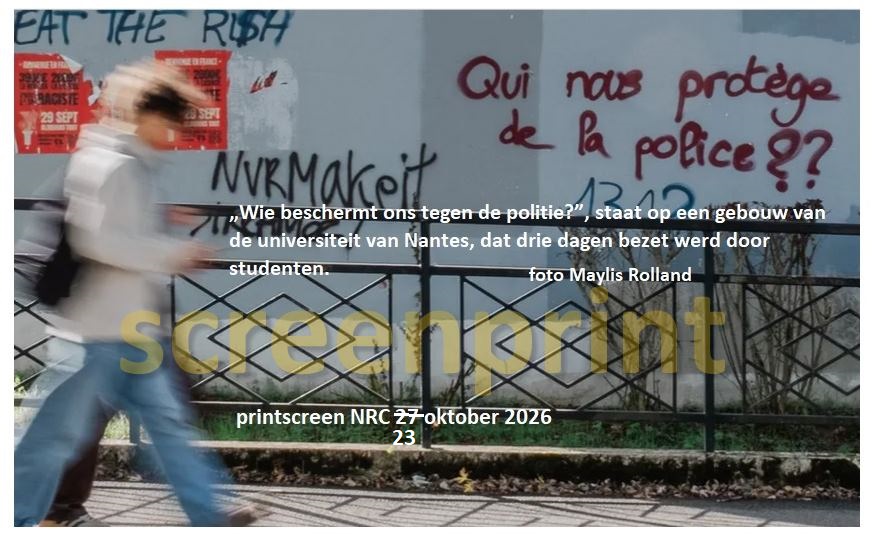





 Gaan we in Nederland die kant op? Nu, met AI, kunnen zulke oplossingen heel snel en vakkundig worden toegepast, neem ik aan.
:format(webp)/s3/static.nrc.nl/wp-content/uploads/2026/08/21121224/260826OPI_2036100769_.jpg)


