Carpenter & Conry, blz. 194: ‘ Not to do so is likely to result in unpleasant surprises, and some realist supporters of NATO expansion got such a surprise as a result of the March 1997 Helsinki summit. At that meeting, so many concessions were made to Moscow by the Clinton administration that we now have an almost lunatic state of affairs: in order to make acceptable the expansion of NATO to contain a potentially dangerous Russia, we are virtually making Russia an honorary member of NATO, with something close to veto power.
Some of the initially most ardent supporters of expansion are now deeply dismayed. But surely such an outcome was foreseeable. After all, the realists knew from the start that the policy they were pushing would be negotiated not by a Talleyrand or a Metternich—or an Acheson or a Kissinger—but by Clinton, the man who feels everyone’s pain. In that instance he felt Yeltsin’s pain—and gave away much of the store. Kissinger has been clear-eyed enough to label that a fiasco and to recognize that there is now an intellectual rift dividing those who advocate NATO expansion: a rift between those who still see the need to preserve NATO as a military alliance against a potential enemy (Russia) and those who now see it in terms of a collective security system embracing a Europe now made whole by the inclusion of Russia. ‘
*
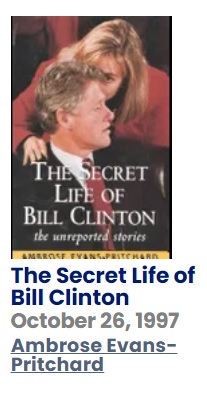
Ambrose Evans-Pritchard: The Secret Life of Bill Clinton: Corruption, Suppressing Evidence of Other Crimes & Scandals (1997) Premiered Apr 10, 2022
The Secret Life of Bill Clinton: The Unreported Stories is a critical biography about certain episodes during the administration of former United States president Bill Clinton by English author and investigative journalist Ambrose Evans-Pritchard.
*
‘ Davidson had the same tutor as Bill Clinton at Oxford, enjoyed Clinton’s “charm and geniality,” and contributed to his 1992 presidential campaign. “I knew he was a bounder, of course, but my hope was that he’d turn out to be the Carlos Menem of North America and slash entitlement spending,” said Davidson.
But questions of economic management were soon overtaken by the much greater issue of the rule of law. For Davidson the Foster cover-up is a marker of the declining integrity of the American democratic system. If the U.S. judicial system cannot summon the courage to deal with this case, if it behaves like the Mexican or the Indonesian or the Nigerian judiciaries, then there is no reason to pay a “rule of law” premium on U.S. stocks, bonds, and real assets.
He recommends investing in countries at a positive stage of the moral and cultural cycle, like Chile, where judges, prosecutors, and police cannot be bought so easily. A Chilean policeman in the 1990s, he asserts with contrarian mischief, is much more honest than a U.S. cabinet officer.
But at a deeper level Davidson is afraid that Foster’s death, which he calls an “extra-judicial execution,” is a sign of incipient fascism. He notes that the Clintons have mastered the art — described by Hannah Arendt in The Origins of Totalitarianism — “of turning all questions of fact into questions of motive.”
The Clintons do not try to rebut allegations. They use surrogates to muddy the waters and smear opponents, just as the National Socialists used to do. That they should be able to employ this practice to obscure the violent death of a top White House aide throws into doubt the durability of the republic.
“A government that winks at murder will wink at anything,” he says, sniffing the aroma of a Corton Charlemagne, Premier Cru. “What’s left after that? Cannibalism?”
Ambrose Evans-Pritchard (1997;Chapter 14) The Secret Life of Bill Clinton: Corruption, Suppressing Evidence of Other Crimes & Scandals ISBN-13: 9780895264084