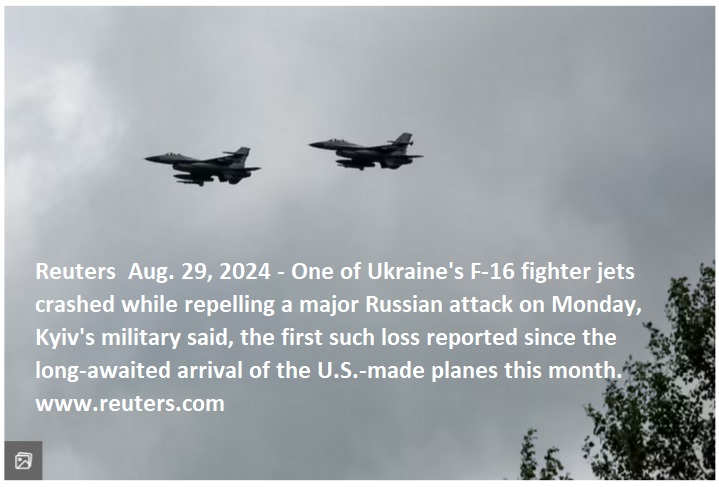
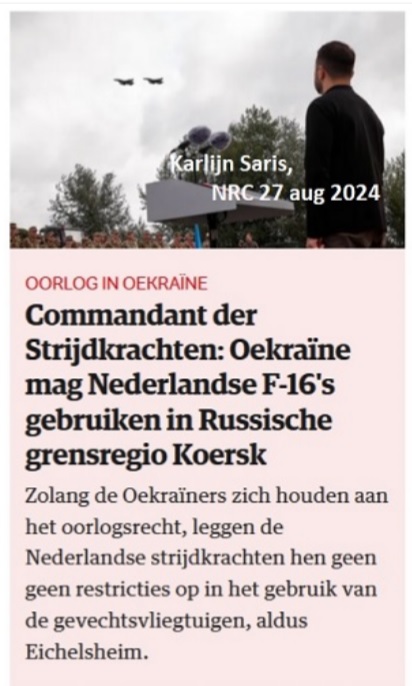
*
‘ Jawel, de Oekraïners mogen de Nederlandse F-16’s gebruiken, mits …. enzovoorts.’
- ‘ Mits ze ermee hebben leren vliegen, bedoel je?’
‘Hoe meer je van dit soort teksten (losse flodders) met elkaar in verband brengt, hoe koddiger – en hopelozer – het verhaal als geheel wordt. Alleen erg sneu voor al die mensen die er het leven bij laten.’
- ‘ Nou ja, we weten niet precies wat er met déze F16 aan de hand was, maar het geheel aan berichtgeving over de poppenkasterij rond Amerika’s proxy-oorlog tegen Rusland, via de Oekraïne (en niet te vergeten de bloederige show in Gaza) doet het vertrouwen in “onze” politiek-miltaire leiders niet echt toenemen.’
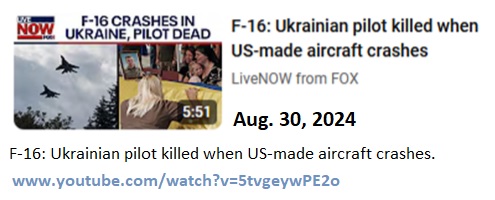
‘Wedden dat de Amerikanen straks met de stille trom zijn vertrokken? Terwijl ze ons in West-Europa met de brokken laten zitten.’
- ‘ In het restaurant van **** hadden een paar dames het erover dat er – als “de boel” slecht gaat – er meer foto’s van “een prinsesje” met bijbehorend narratiefje – in de media lijken te verschijnen.’
‘ Alexia lijkt de poster-prinsessenrol te spelen. Amaila wordt vaagjes wel of niet bedreigd. “Alleen de jongste prinses – Ariane – blijft vooralsnog buiten beeld. Wat zou haar schelen?” De mensen zijn natuurlijk niet helemaal gek, alleen is het besef dat je voortdurend met open ogen bij de neus genomen wordt, niet bepaald opbeurend voor de nationale spirit, zou ik denken.’
……………. …………….. …………………….
……………. …………….. …………………….
citaat uit Seymour Melman (1974: 159-160) The permanent war economy. ISBN-13: 9780671218119; ISBN 0-671—21811-5; ISBN 0-671—22261-9 pbk.
The name of the principal military agency of the U.S. government is the Department of Defense. Can that department defend the United States? If not, and the evidence points in that direction, then, on grounds of elemental honesty in public affairs, isn’t that a limit that should be known, discussed and taken into account as a population is marshaled to support escalating military budgets in the name of defense that cannot be delivered?
The ideologists of military power and of the economic necessity of war economy have had virtually clear sailing in their continuing program of justifying their expropriations of public wealth. However, the U.S. government’s military, political and economic operations in Vietnam have been part of a very expensive lesson, paid for mainly by the benighted people of Vietnam, that military power, even U.S. military power, has limits. In order to set the stage for a discussion of limits of military power I will first summarize the capabilities of the armed forces of large, mainly nuclear-armed nations:
- The nuclear (and nonnuclear ) forces can be used to threaten other states and populations with destruction.
- The nonnuclear armed forces of major states can be used to assault smaller, nonnuclear states, except as that would lead to military confrontation between nuclear powers—for example, the United States versus the U.S.S.R. in Cuba, 1962.
- Armed forces of major countries can be used to occupy the territories of other countries, mainly under conditions that involve formal agreements between governments, as for military bases.!
- Smaller states can use military power for limited periods of time for assaulting other small states—for example, the Six Day War in the Middle East, 1967. Large and small governments can use armed forces for internal police operations to maintain the rule of a particular government.
This enumeration of the present functions of armed forces, especially of major states, appears to omit a traditional part of the purposes of armed forces—that is, for shielding a country from external attack and winning wars that subdue the armed forces of lesser states. This omission reflects one of the main characteristics of the new limits on military power that have developed during the nuclear era.
* * *