‘ Had jij ooit van het Azov Regiment gehoord?’
– ‘ Jawel, heel lang geleden en vaagjes. Van iemand die vertelde dat hij in het Franse Vreemdelingenlegioen had gediend, en dat hij met jongens van Azov in een compagnie zat. Maar dat was een verhaal, van een verhaal, over een verhaal. Daarna kwam Azov nog een keer ter sprake op een feestje met Russen en veel vodka, en heb ik er wat over opgezocht. Het fijne ervan staat me niet meer bij. Het schijnen niet bepaald frisse knapen te zijn. Hoezo?’
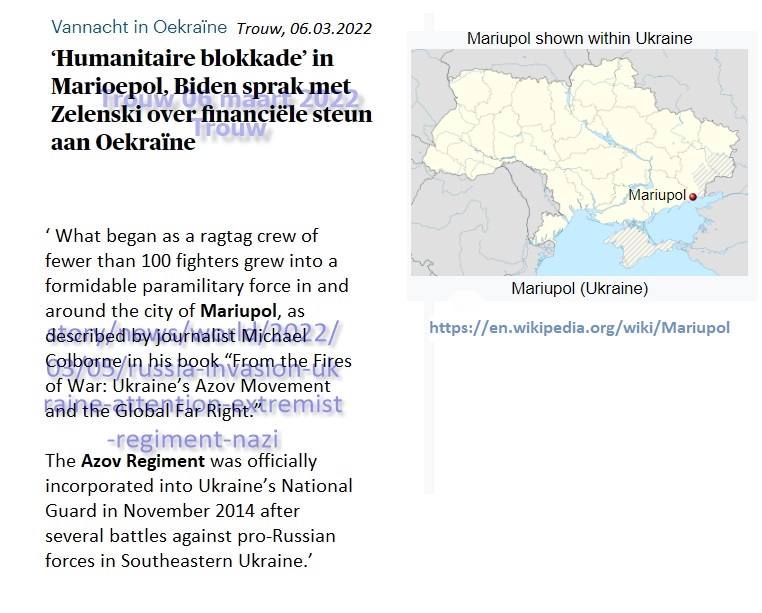
‘ In de Trouw en NRC staan stukjes over Mariupol en ik meende dat die Azov-jongens daar in de buurt waren opgericht, of zoiets. Marienpol. Ik bedacht dat Putins uitlatingen over nazi’s in de Oekraïne, hier in de MSM worden toegeschreven aan Putin’s waanideeën en onder oorlogspropaganda worden weggelachen. Zou Putin toch ergens over praten waarvan wij in het Westen niets weten? Putin schijnt vooral (ook) die Azov-jongens te willen opdoeken. De vraag is of Putin’s move “proportioneel” is.‘
– ‘ Het zou mij niet verbazen wanneer Putin Azov als stok gebruikt om de hond te slaan. Aan de andere kant: wat weten wij van de dreiging die hij van Azov vindt uitgaan, en of hij die juist inschat? Liever te hard geblazen dan de mond gebrand. De MSM hier weten vaak heel weinig over de dingen waar ze over schrijven en ze bouwen elkaar na, en ze putten uit dezelfde (onbetrouwbare) bronnen. Ik heb hier niets over Azov gelezen. Wat als er tussen de Oekraïnse vluchtelingen Azov-lieverdjes binnen sluipen? Zet het op de site. We zien wel wat de jongelui erop zeggen. Of niet.’
*
al Jazeera 01 maart 2022 >> ‘ The far-right neo-Nazi group has expanded to become part of Ukraine’s armed forces, a street militia and a political party.
As the Russian invasion of Ukraine enters its sixth day, a Ukrainian far-right military regiment is back in the headlines.
Russian President Vladimir Putin referenced the presence of such units within the Ukrainian military as one of the reasons for launching his so-called “special military operation … to de-militarise and de-Nazify Ukraine”.
So what is the Azov regiment?
Azov is a far-right all-volunteer infantry military unit whose members – estimated at 900 – are ultra-nationalists and accused of harbouring neo-Nazi and white supremacist ideology.
The unit was initially formed as a volunteer group in May 2014 out of the ultra-nationalist Patriot of Ukraine gang, and the neo-Nazi Social National Assembly (SNA) group. Both groups engaged in xenophobic and neo-Nazi ideals and physically assaulted migrants, the Roma community and people opposing their views.
As a battalion, the group fought on the front lines against pro-Russian separatists in Donetsk, the eastern region of Ukraine. Just before launching the invasion, Putin recognised the independence of two rebel-held regions from Donbas. <<
*
The ‘de-Nazification’ myth. – eu.usatoday.com/story/news/world/2022/03/05/russia-invasion-ukraine-attention-extremist-regiment-nazi/9368016002/
In a speech announcing the attack on Ukraine, Russian President Vladimir Putin said he aims to “de-Nazify” the country.
On its face, the statement was baffling. Ukraine, a sovereign democratic nation led by a Jewish president whose family was almost wiped out in the Holocaust, is categorically not, as Putin would like people to believe, beholden to neo-Nazis, according to several experts and political scientists who spoke with USA TODAY.
The Azov Regiment is part of Ukraine’s broader “Azov Movement,” which has at its core white supremacist and anti-Semitic philosophy. But the extremist-right commands support from at best perhaps 2% of the Ukrainian electorate, according to one prominent political scientist.
Compared to other countries in Eastern and even Western Europe, Ukraine’s neo-Nazi problem is a fringe issue, said Daveed Gartenstein-Ross, CEO of Valens Global, an international strategy and security company.
Gartenstein-Ross said there’s a huge difference between a regiment with a checkered history playing a minor part on the battlefield and the notion that Ukraine is somehow overrun by neo-Nazis, as Putin has long pretended.
“The small, marginal presence of Azov does not justify a Russian invasion, on the pretense of de-Nazification,” Gartenstein-Ross said.
*
Michael Colborne – Foreign Policy – 17.04.2019
‘Ukraine’s Azov movement is hostile to Russia, friendly to neo-Nazis, and inspired by France’s new right. It’s not running in Ukraine’s presidential elections because it plans to win power by playing a long game.’