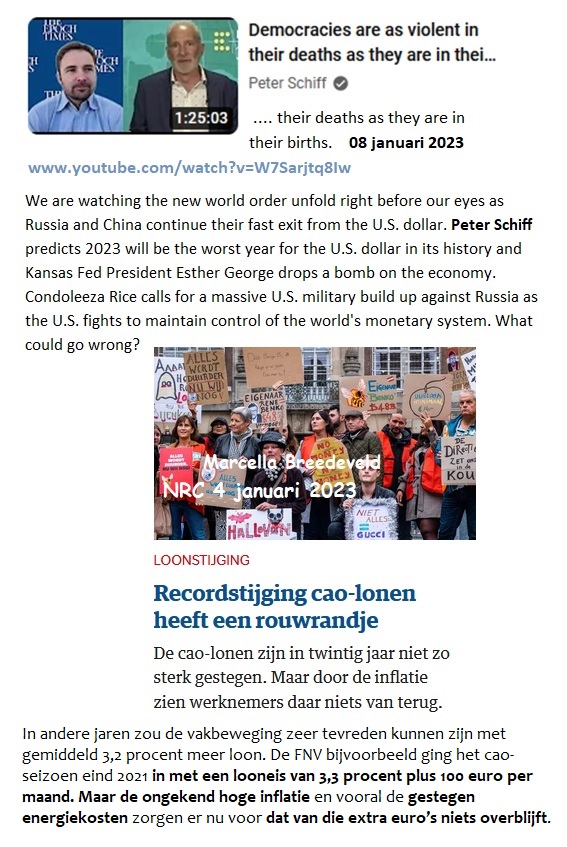
Peter Schiff – Democracies are as violent in their deaths as they are in their births.
*
> * > geredigeerd citaat uit Peter Schiff: The Real Crash ; vet toegevoegd < * < You cannot speak intelligently about the root causes of the 2008 crash—or about our current instability—without speaking about the Federal Reserve System of the United States (the Fed).
The Fed sets interest rates, it controls the money supply, it is effectively the main lender to the United States Government, and the lender of last resort to the banks, and it is the core of the Bush-Obama bailout machine. The Fed has always been quietly at the heart of the economy’s ups and downs, but since bailout mania began in March 2008 with the Fed’s bailout of Bear Stearns, there’s no ignoring it anymore.
And if you study all the facts, there’s also no ignoring that the Fed, rather than the agent of stability it was supposed to be, is an inflation machine and a facilitator of big government, creating bubbles, causing waste, and now, setting us up for an economic downturn that could be worse than the Great Depression.
So if we are to trace the recent economic troubles back to their roots, we need to start in 1913 with the creation of the Fed.
The original intention of the Fed was something I might have supported had I been around back then. In theory, it was an agent of stability that could also promote economic growth.
Today, the Fed increases the money supply when the economy grows, then expands it even faster as it contracts. Not only is this the exact opposite of what it was intended to do, but had such a harebrained scheme been proposed in the beginning, the Federal Reserve never would have seen the light of day.
The role of a central bank is limited: to control the currency so as to keep prices and interest rates fairly stable. Spurring job creation and achieving economic growth were not part of the mandate. Saving failed banks was certainly not part of the job. And the Fed’s main role today—propping up government spending with money made out of thin air—was certainly not part of the original pitch, because the Fed was at first prohibited from buying government debt.
This sort of central bank is one I could have supported. But the Federal Reserve Bank of the United States never functioned this way, and it probably was never meant to. However, for the same reason one should never allow the camel to get its nose under the tent, we never should have trusted the Fed to respect its boundaries.
Wars involve huge new costs to government. Governments can cover these wartime costs with cuts to domestic spending. They can also raise taxes, calling on a sense of common sacrifice. As a third option, governments can borrow, selling “war bonds” to investors. < * <
Bron: The Real Crash (2012 ) by Peter D. Schiff. ISBN 978-1-25000835-0 (e-book)