* PARKEER *
//external-content.duckduckgo.com/iu/?u=http%3A%2F%2Fd.ibtimes.co.uk%2Fen%2Ffull%2F1640953%2Fernesto-che-guevara.jpg&f=1&nofb=1&ipt=bf00a96a389beb6827003e590adabc90e76f413b23fbe341251c059f9e84cffb&ipo=images

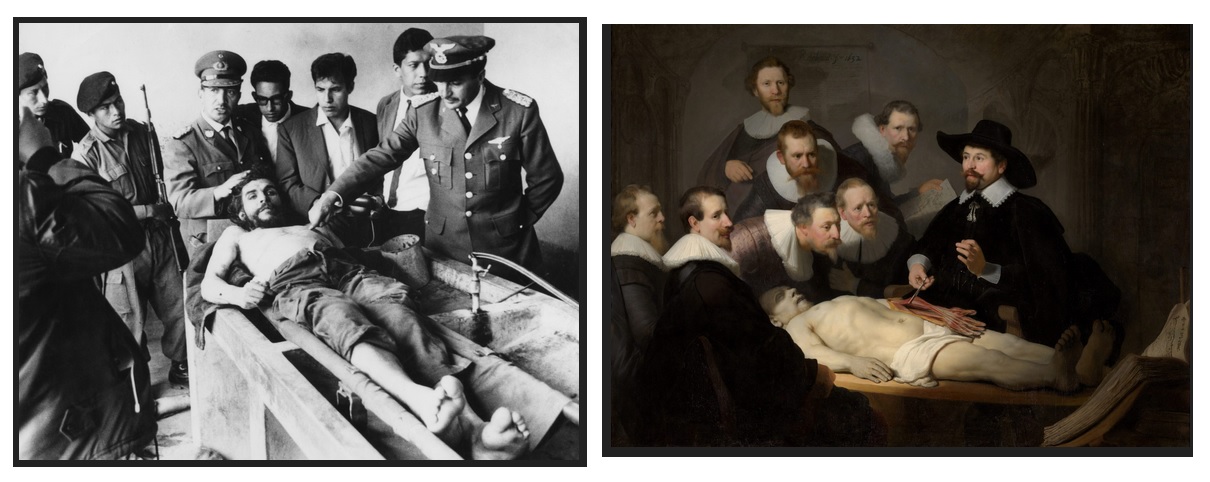
‘ On Tuesday, 10 October 1967, a photograph was transmitted to the world to prove that Guevara had been killed the previous Sunday in a clash between two companies of the Bolivian army and a guerrilla force on the north side of the Rio Grande river near a jungle village called Higueras
Now he is dead. The chances of his survival were in inverse ratio to the force of the legend. The legend had to be nailed. ‘If,’ said The New York Times, ‘Ernesto Che Guevara was really killed in Bolivia, as now seems probable, a myth as well as a man has been laid to rest.’
We do not know the circumstances of his death. One can gain some idea of the mentality of those into whose hands he fell by their treatment of his body after his death. First they hid it. Then they displayed it Then they buried it in an anonymous grave in an unknown place. Then they disinterred it. Then they burnt it. But before burning it, they cut off the fingers for later identification. This might suggest that they had serious doubts whether it was really Guevara whom they had killed. Equally it can suggest that they had no doubts but feared the corpse. I tend to believe the latter.
The purpose of the radio photograph of 10 October was to put an end to a legend. Yet on many who saw it its effect may have been very different. What is its meaning? What, precisely and unmysteriously, does this photograph mean now? I can but cautiously analyse it as regards myself. There is a resemblance between the photograph and Rembrandt’s painting of The Anatomy Lesson of Professor Tulp. The immaculately dressed Bolivian colonel { [ with a handkerchief to his nose] ?} has taken the professor’s place. The two figures on his left stare at the cadaver with the same intense but impersonal interest as the two nearest doctors on the professor’s left. It is true that there are more figures in the Rembrandt – as there were certainly more men, unphotographed, in the stable at Vallegrande. But the placing of the corpse in relation to the figures above it, and in the corpse the sense of global stillness – these are very similar.
Nor should this be surprising, for the function of the two pictures is similar: both are concerned with showing a corpse being formally and objectively examined. More than that, both are concerned with making an example of the dead: one for the advancement of medicine, the other as a political warning. ‘
John Berger: Image of Imperialism (geredigeerd fragment) eISBN: 978-0-30749070-4
*
[A]mericans have long had an authoritarian streak. It was not unusual for figures such as Coughlin [Father Charles Coughlin, an anti-Semitic Catholic priest], [Huey] Long, [Joseph] McCarthy, and [George] Wallace to gain the support of a sizable minority—30 or even 40 percent—of the country.
We often tell ourselves that America’s national political culture in some way immunizes us from such appeals, but this requires reading history with rose-colored glasses. The real protection against would-be authoritarians has not been Americans’ firm commitment to democracy but, rather, the gatekeepers—our political parties.
In parliamentary democracies, the prime minister is a member of parliament and is selected by the leading parties in parliament, which virtually ensures that he or she will be acceptable to political insiders. The very process of government formation serves as a filter.
Presidents, by contrast, are not sitting members of Congress, nor are they elected by Congress. At least in theory, they are elected by the people, and anyone can run for president and—if he or she earns enough support—win.
Our founders [i.e. in Amerika] were deeply concerned with gatekeeping. In designing the Constitution and electoral system, they grappled with a dilemma that, in many respects, remains with us today. On the one hand, they sought not a monarch but an elected president—one who conformed to their idea of a republican popular government, reflecting the will of the people. On the other, the founders did not fully trust the people’s ability to judge candidates’ fitness for office. Alexander Hamilton worried that a popularly elected presidency could be too easily captured by those who would play on fear and ignorance to win elections and then rule as tyrants.
The device the founders came up with was the Electoral College. The Electoral College, made up of locally prominent men in each state, would thus be responsible for choosing the president.
Men with “talents for low intrigue, and the little arts of popularity” would be filtered out. The Electoral College thus became our original gatekeeper.
The rise of parties in the early 1800s changed the way our electoral system worked. Instead of electing local notables as delegates to the Electoral College, as the founders had envisioned, each state began to elect party loyalists. Electors became party agents, which meant that the Electoral College surrendered its gatekeeping authority to the parties. The parties have retained it ever since. Parties, then, became the stewards of American democracy.
An overreliance on gatekeeping is, in itself, undemocratic—it can create a world of party bosses who ignore the rank and file and fail to represent the people. But an overreliance on the “will of the people” can also be dangerous, for it can lead to the election of a demagogue who threatens democracy itself. There is no escape from this tension. There are always trade-offs.
Levitsky & Ziblatt (geredigeerd fragment)
n.a.v. hetgeen zich momenteel bij de conservatives (Tory) in GB afspeelt. Boris Johnson > Liz Truss > Rishi Sunak. Hoe kunnen we ons de Nederlandse “democratie” in deze context voorstellen? Wie trekken er de facto (achter de schermen) aan de touwtjes? Welke rol (of rollen) speelt een Mark Rutte? Wat gaat er met onze pensioenkas gebeuren, hoe wordt de allernieuwste Covid-variant ingezet? Wordt Vladimir Putin tot een kernoorlogje gekieteld? Door wie precies?
Welke rol spelen bijvoorbeeld McKinsey, het WEF, Rothschild ( > Macron en Sunak), Israel (Benjamin Netanjahu seems to be on the prowl – ostensibly promoting his latest book….), andere (onzichtbare en onbekende) spelers ?